
Beginner Full-Body Workout Plan (At Home, No Gear)
A real 3-day full-body plan for home with no equipment — the exact session, the weekly schedule, and how to make it harder as you get stronger.
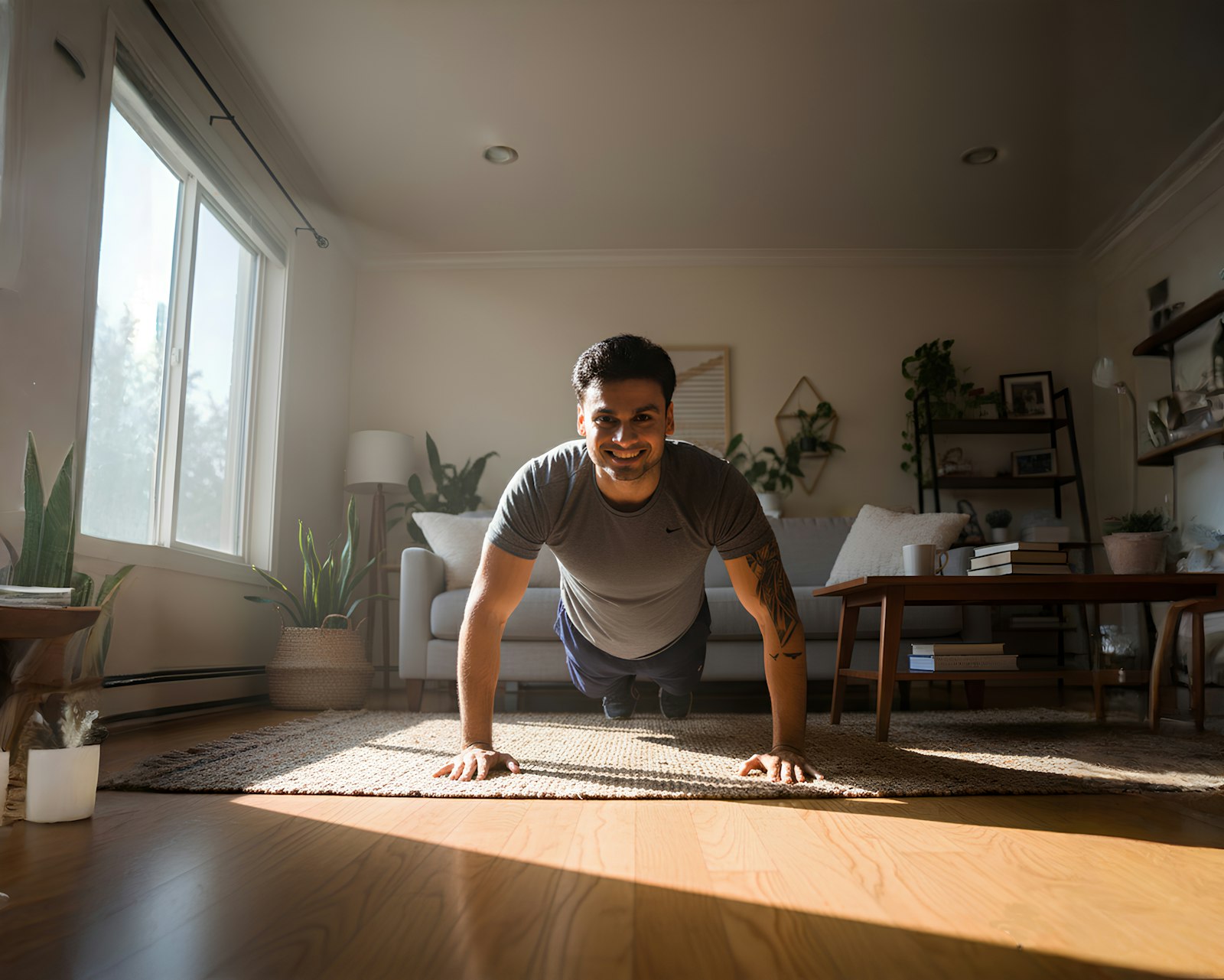
Most “beginner workout plans” you find online aren’t plans. They’re a list of exercises with a number of reps next to each one, and a quiet assumption that you’ll figure out the rest — when to do them, how often, what to do next week, how to make them harder, and how to keep going once the new-year energy wears off. That missing structure is the actual plan, and it’s the part that decides whether you’re still training in March.
So this is the structure. Not “how to do your first session” — that’s a different, earlier question, and how to start working out at home already answers it. This is the multi-week scaffold that sits on top: three full-body days a week, no equipment, a real session you can run today, and a clear rule for making it harder as you get stronger. By the end you’ll have a plan you could follow for two or three months without checking another article.
Why full-body, three days a week
Before the exercises, the shape — because the shape is what makes it work.
A beginner plan should hit each major muscle group about twice a week. That’s not a random number. A systematic review and meta-analysis by Schoenfeld, Ogborn, and Krieger found that training a muscle twice a week produced superior growth to training it once, concluding that “major muscle groups should be trained at least twice a week to maximize muscle growth.” Three full-body sessions is the simplest way to land there: every session trains everything, so by Friday your legs, chest, back, and core have each been worked two to three times. No tracking spreadsheet required — the schedule does it for you.
It also lines up with the floor the official Physical Activity Guidelines and the CDC set: muscle-strengthening activity that works all the major muscle groups on two or more days a week. Three days clears that bar with a little room to spare, which is exactly where a beginner wants to be — enough stimulus to adapt, enough recovery to keep showing up.
If you’re wondering whether you should be doing more — five days, a “chest day,” the whole bodybuilder split — hold that thought. We dug into exactly why three is the right number to start, and why more isn’t better yet, in how many days a week a beginner should work out. And if you want the case against splitting your body across separate days this early, that’s its own post too: full-body vs split workouts for beginners. For now, trust the shape: three full-body days, with a rest day between them.
The weekly schedule
Here’s the calendar. Two layouts — pick whichever fits your life:
- Mon / Wed / Fri — the classic. A rest day between each session, weekend off.
- Tue / Thu / Sat (or any every-other-day pattern) — same idea, shifted.
The only rule that matters: don’t stack all three sessions back-to-back. You want at least one day off between them, because the adaptation that makes you stronger happens during recovery, not during the workout. Beyond that, the days are flexible. Life moved Wednesday’s session to Thursday? Fine. The plan survives that. It does not survive you quitting because you missed one day — which is a different problem, and a solvable one (more on that at the end).
You’ll alternate between two sessions, Workout A and Workout B, so nothing gets stale and both sides of every movement pattern get covered:
- Week 1: A — B — A
- Week 2: B — A — B
- Week 3: A — B — A … and so on.
Workout A
Do these in order. Rest 45–75 seconds between sets — long enough that the next set is hard because the muscle is tired, not because you’re out of breath. The rep ranges are wide on purpose: aim for the bottom of the range when a move is new, climb toward the top as it gets easier.
- Bodyweight squats — 3 sets of 10–15. Sit back like there’s a chair behind you; knees track over toes; stand all the way up.
- Incline push-ups (hands on a couch, counter, or stairs) — 3 sets of 8–12. The higher your hands, the easier it is. Start higher than you think you need to.
- Reverse lunges — 2–3 sets of 8–10 per leg. Step backward, drop the back knee toward the floor, drive up through the front heel.
- Glute bridges — 3 sets of 12–15. Lie on your back, knees bent, push your hips to the ceiling, squeeze at the top for a beat.
- Plank — 3 sets of 20–40 seconds. Straight line from head to heels; don’t let your hips sag.
Workout B
- Split squats (one foot forward, one back, drop straight down) — 3 sets of 8–12 per leg. The unilateral cousin of the squat; it’ll humble you at first.
- Doorway rows or floor “supermans” — 3 sets of 10–15. For rows: grab both sides of a sturdy doorframe, lean back with straight arms, pull your chest to the frame. No suitable doorway? Lie face-down and lift your chest and arms off the floor instead. This is your pulling movement — the one bodyweight plans most often skip, and the reason a lot of home programs leave the upper back under-trained.
- Incline push-ups — 3 sets of 8–12. Yes, again. Pushing twice a week is the point.
- Single-leg glute bridges — 2–3 sets of 8–10 per leg. Same as the regular bridge, one foot off the floor. A big jump in difficulty for the same zero equipment.
- Side plank — 2 sets of 15–30 seconds per side.
That’s it. Five moves, roughly 25–35 minutes including rest. Short enough to actually do on a Wednesday you didn’t feel like it.
How to make it harder (the part most plans forget)
A plan that never changes stops working the day your body adapts to it — usually around week three. The fix isn’t adding weight you don’t have; it’s raising the demand with the levers you do have. We cover the full toolkit in progressive overload without weights, so here’s just the rule you need to run this plan:
Each session, try to beat the last one by a little. Concretely:
- First, add reps. When you can hit the top of the rep range on all sets — say, 15 squats every set — that move is telling you it’s ready for more.
- Then, make the movement harder. Lower your push-up hands one notch (counter → couch → stairs → floor). Swap regular bridges for single-leg. Move squats toward a slow 3-second lowering phase. Each of these is a “heavier” version of the same exercise with no equipment involved.
- Then, reset and climb again. Once you’re at the bottom of the range on the harder version, you’re back to building reps. Repeat.
The reason this works at all is that your muscles respond to effort near the limit, not to the object causing it. When sets are taken close to failure, light loads build muscle about as well as heavy ones — a meta-analysis by Schoenfeld and colleagues found comparable strength and size gains across low and high loads. “Hard because there’s no chair left to put my hands on” counts. You’re not doing a watered-down version of “real” training. You’re doing the thing that makes training work.
If the why does this work without a gym question is itching at you, we settled it separately so this plan didn’t have to: are home workouts effective. Short version — yes, and the research is on its side.
How long before it works
Honestly? You’ll feel the first changes faster than you’ll see them. In the first couple of weeks the moves start feeling smoother and more controlled — that’s your nervous system getting efficient, not your muscles growing yet. Strength and visible changes build over the following weeks and months with consistent progression. That’s the normal, healthy arc, and chasing a faster one is how people burn out.
Because expectations are where most beginners quietly give up — “it’s been two weeks, where are my results?” — we mapped the realistic week-by-week timeline in its own post: what to expect from a beginner plan, weeks 1 to 12. Read it before you judge whether this is working. It’ll save you from quitting right before the good part.
Which question is actually yours?
This plan raises three predictable follow-ups. Jump to whichever one is yours:
“Three days feels like too few — shouldn’t I do more?” This is the frequency question, and the instinct to do more is the most common beginner mistake. Why three full-body days is the sweet spot, why each muscle getting hit ~2x/week is the goal, and why adding days too early backfires: how many days a week should a beginner work out. (For the bigger-picture principle beyond this plan, that links onward to how often you should work out.)
“Why full-body? My friend does a chest day, a leg day…” That’s the split question. Bro-splits are built for advanced lifters with years of training and five-plus gym days; for a beginner they mean each muscle gets trained once a week and one missed session blows a hole in your whole week. The full case: full-body vs split workouts for beginners.
“How fast should I expect results — and how do I know it’s working?” The expectations question. What’s realistic at weeks 1, 4, 8, and 12 — coordination first, then strength, then the visible stuff — without anyone selling you a fantasy: beginner workout plan results timeline.
And the recovery side of the plan — how many rest days you actually need between these sessions — lives in how many rest days a week.
Where the plan stays alive past week two
You now have a genuinely complete plan. The thing it can’t do — the thing no article or PDF can do — is run with you on the Wednesday you’d rather not. That’s where almost every beginner plan dies: not from a bad program, but from an abandoned one.
That gap is what OgamicX is built to close. The schedule above isn’t a metaphor in there — it ships as actual templates: 30 prebuilt no-equipment bodyweight workouts with a built-in weekly structure, so “what’s today’s session” is already answered and “make it harder” is already sequenced for you. Every session you finish feeds one unified streak — a small, weirdly effective reason to show up on the days motivation doesn’t. And if you go quiet, Ogi, the in-app coach, checks in with a Care Plan nudge instead of letting the plan rot silently in week two. It’s free to start (no card, no trial games); three active templates and the core tracking are free forever, and Premium ($4.99/mo) adds an AI-built plan tailored to you and more enrollments if you want them later. The plan isn’t the hard part — you’ve got the plan now. Keeping it is, and that’s the part software is actually good at holding for you.
The bottom line
A real beginner plan is three full-body, no-equipment days a week, with a rest day between them, alternating two short sessions, and one rule for getting harder: beat last time by a little. That’s enough to hit every muscle twice a week, clear the guidelines, and build real strength and muscle from your living room. You have the whole thing above — the schedule, the exact session, and the progression. Pick your start day, run Workout A, and let the plan do the planning from here.
Keep going:

Written by
The OgamicX Team
Tips, guides, and insight on fitness, nutrition, fasting, and building habits that last — from the team behind OgamicX.
About OgamicXFound this useful? Share it.