
At-Home Workouts for Parents (No Gym Needed)
Home is the parent's format: no commute, no childcare, no gear. Quiet nap-time moves and train-with-the-kids routines that fit.
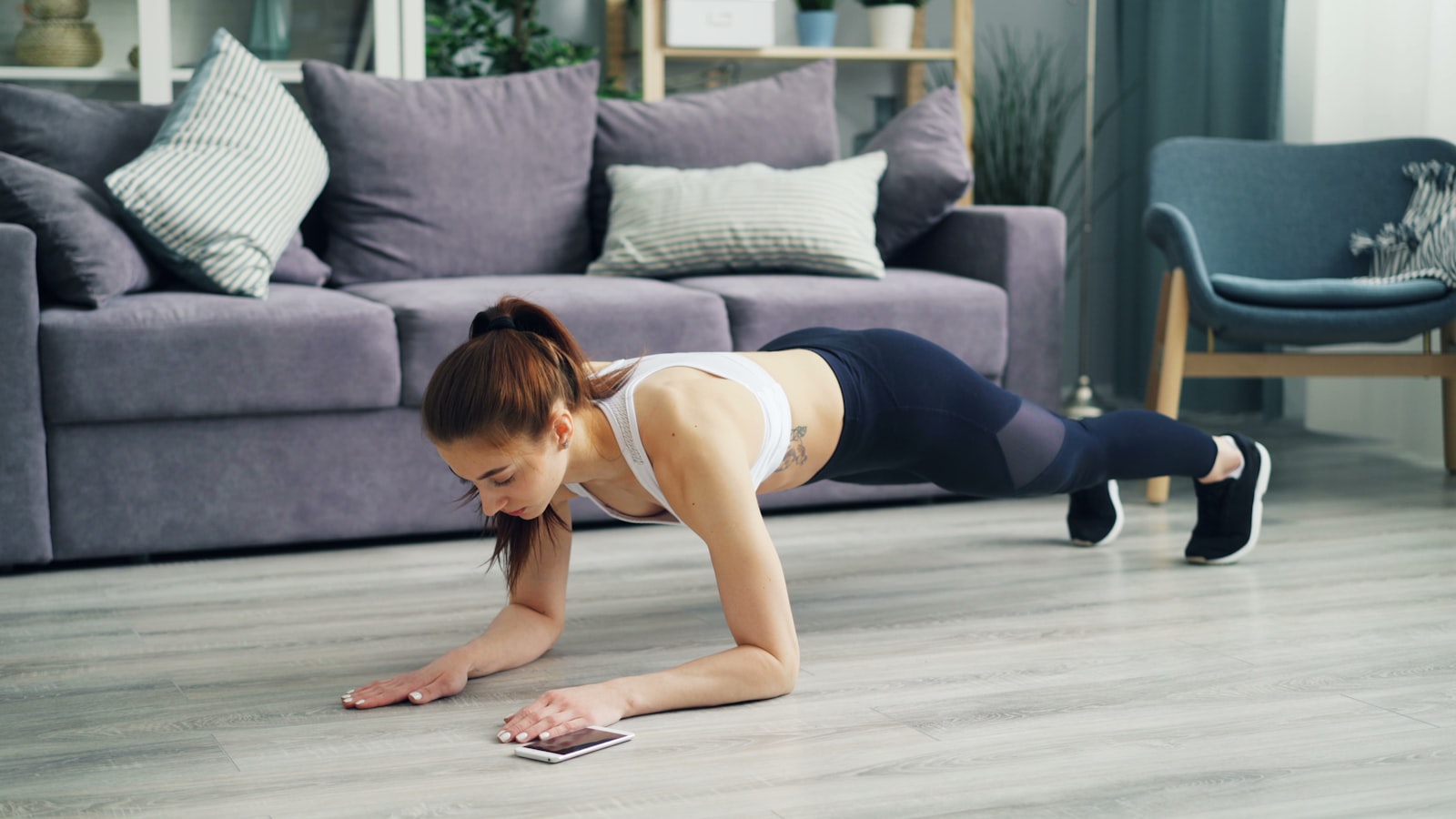
The gym membership made sense when you bought it. Then the baby came, and now it’s a $40-a-month donation to a building you drive past on the way to daycare. The math of a parent going to the gym is brutal once you add it up: the commute there and back, the childcare you either pay for or guilt-trade with your partner, the packing, the parking. You’re spending ninety minutes of logistics to buy thirty minutes of squats — and that’s on a day nothing goes wrong, which is never.
So here’s the unlock that gives a lot of parents their fitness back: skip the building entirely. Train at home, with your bodyweight, in the gaps your day already has. No commute, no childcare hand-off, no equipment to buy or store. Just you, the living-room floor, and ten minutes. And before you write that off as the lazy compromise — it isn’t. Home bodyweight training is genuinely effective, and for a parent it’s not the fallback option. It’s the better one.
Home workouts actually work — this isn’t a consolation prize
The doubt is understandable, because an entire industry is paid to plant it. Gyms, equipment brands, and cable-machine companies all need you to believe that “real” results require their stuff. They have a financial reason to say so. The research doesn’t back them up.
When the effort is real, bodyweight training builds genuine strength and muscle. In a randomized controlled trial, progressive bodyweight squats produced similar gains in leg strength and muscle thickness as barbell back squats in previously sedentary women — the researchers concluded bodyweight squat training “can be used as an alternative to traditional resistance training.” No rack, no plates, just smart progression in a living room. Your muscles respond to challenge and effort, and they genuinely cannot tell whether the difficulty came from a heavy barbell or from a tough single-leg variation on your carpet.
We make the complete evidence-based case in are home workouts effective — the short version is yes, comfortably, for everything most parents actually want: strength, muscle, conditioning, feeling good in your body. The gym extends the ceiling for serious lifters chasing a big one-rep max. It does not decide whether you get fit. Your consistency does — and home is where a parent can actually be consistent.
Why home is the parent’s format, specifically
Beyond “it works,” home training solves the three logistics problems that quietly defeat most parents — and it solves all three at once:
- No gym, no commute. The workout is wherever you’re standing. The biggest reason a parent skips a session — “I don’t have time to get there” — simply evaporates. Zero travel time means the session can happen in a window too small for the gym to ever fit into.
- No childcare. You don’t need anyone to watch the kids, because you’re right there with them. You can train while they nap, while they play on the floor beside you, or while they’re in the bath and you’re supervising. The supervision problem and the workout problem collapse into the same ten minutes.
- No equipment. Your bodyweight is the gear, and it’s always with you. Nothing to buy, nothing to store in a house already overflowing with tiny shoes and plastic toys, nothing that becomes a guilt-inducing clothes rack in six months.
And you don’t need long stretches of it. The CDC’s 150 minutes of moderate activity a week can, in the guidelines’ own words, be spread “out during the week” and broken “up into smaller chunks of time” — which is to say, accumulated in exactly the ten-minute living-room windows a parent’s day actually contains. Each of those barriers above is a thing that ends fitness runs. Home training removes all three in one move. If you’re not sure where to even begin, how to start working out at home is the gentle on-ramp; this post is about the parent-specific tactics on top of it.
Quiet, low-impact moves for nap time
The nap window is a parent’s most reliable slot — but it comes with one rule: do not wake the baby. That means no jumping, no thudding, no burpees over a thin floor with a sleeping kid on the other side of the wall. Good news: you can get a genuinely hard workout with zero noise. Effort doesn’t require impact.
A silent nap-time circuit might look like:
- Squats — controlled, no jump. Slow them down or pause at the bottom to make them harder without making them louder.
- Push-ups — on the floor, on your knees, or against the wall. Dead silent, scalable to any level.
- Glute bridges — flat on your back, lifting the hips. Brutal on the glutes, completely noiseless.
- Lunges and reverse lunges — step back instead of forward to protect the knees and stay balanced and quiet.
- Planks and dead bugs — core work that makes literally no sound.
- Wall sits — hold while you scroll your phone. Quiet, miserable, effective.
String five or six of these into a circuit and you’ve got a real session that won’t disturb a single nap. The way to make any of them harder without getting louder is to slow the tempo and add pauses — time under tension does the work that a thump would otherwise do. The principle of making bodyweight moves progressively harder is the whole game, and it’s worth understanding well.
When the kids are awake: train with them, not around them
Nap time is great until they outgrow naps, or the nap is the one thing you’re guarding for your own sanity. So the other mode is training with the kids underfoot — which sounds like a non-starter and is actually one of the best setups going, because it removes the supervision problem entirely.
- Get on the floor with them. While a baby does tummy time or a toddler plays, you do your push-ups, planks, and bridges right there on the same mat. You’re supervising and training in the identical ten minutes.
- Use them as weight. A toddler is a wriggling, giggling load. Squats and lunges while holding a kid are legitimately hard, and they treat it as the world’s best carnival ride.
- Make it a game. “Let’s see who can hold a plank longest” or “copy my ten jumping jacks” turns your set into their playtime. Kids are relentless mimics — lean into it.
- Narrate and let them join. When they inevitably climb on you mid-push-up, that’s not the workout ruined. That’s added resistance and a core memory in one.
There’s a long-game payoff most parents don’t clock in the moment: your kids grow up watching movement be a normal, daily, non-negotiable part of life. You’re not just getting your reps — you’re quietly handing them a template. That’s a return no gym membership pays.
Keep it simple — you don’t need a program, you need a default
The trap parents fall into is over-engineering. They go looking for the perfect plan, the optimal split, the ideal weekly structure — and the research-and-planning phase becomes one more overwhelming task that never converts into an actual workout. For a sleep-deprived parent, complexity is the enemy. Simplicity is what survives.
So don’t build a program. Build a default — one short, repeatable circuit you can do without thinking, so there’s no decision to make when a ten-minute window opens. Something like: squats, push-ups, lunges, glute bridges, plank — three rounds, done. That’s it. You can run that on the living-room floor, in a hotel room, in the five minutes before the kids wake up, anywhere. Having one bulletproof default beats having a perfect plan you have to look up, because the look-up is friction, and friction is where parent workouts die. (For a deeper menu of squeeze-it-in formats, short workouts for a busy schedule has you covered.)
The point of a default is that it removes thinking. A tired parent at the end of a long day has no decisions left in the tank — so the workout has to require zero. You don’t choose; you just run the circuit you always run. Decision made in advance, every time.
The real challenge isn’t the workout — it’s the week
Here’s the honest part. Everything above — the silent circuit, the kid-as-kettlebell, the bulletproof default — is the easy half. None of it is hard to do once. The hard part, the part that actually decides whether you’re fitter in six months, is doing it through a week that keeps falling apart.
Because the home setup removes the logistics barriers, but it can’t remove the chaos. The kid still gets sick. The nap still gets skipped. The night still gets sleepless. And on those days, the threat isn’t the missed session — it’s the quiet decision that the whole run is ruined, the spiral from one missed day into a stopped habit. Beating that is a separate skill from knowing what to do on the floor, and it’s the one that matters most. We give it the full treatment in staying consistent when life is unpredictable — read it after this one, because the moves are useless if the week wins.
How OgamicX fits the parent-at-home setup
If your obstacle was the gym, the commute, and the childcare, then an app that lives in your pocket and needs none of them is the natural fit. That’s exactly what OgamicX is built for.
The core is 30 prebuilt bodyweight templates — home workouts, no equipment, no gym, no childcare required, sequenced as actual progressions so “what do I do today” is already answered (and built to keep getting harder as you do, which is the part that makes home training keep working). They’re calibrated by emphasis, and you can run them quietly on the living-room floor during a nap or alongside the kids. Every session you log feeds one unified streak — and because any logged activity keeps it alive, even a scanned meal on a day the workout never happened, your chaotic parent-days still count. When a day is genuinely impossible, a Streak Shield covers the miss so your run doesn’t reset over a sick kid, and the Care Plan checks in when you go quiet — a nudge signed “- Ogi,” not a guilt trip.
It’s free to start — no card, no trial games. Three active templates and core tracking are free forever; Premium ($4.99/mo) adds an AI-built plan and more enrollments later if you want them. The whole thing assumes your life is unpredictable and is built to bend around it, which is more than most gym memberships ever did.
The bottom line
Working out at home isn’t the compromise a parent settles for — it’s the format actually built for a parent’s life. It works (the research on bodyweight training is clear), and it deletes the three barriers that defeat most parents at once: no gym, no commute, no childcare, no equipment. Keep a quiet circuit ready for nap time, pull the kids into the session when they’re awake, and run one bulletproof default so there’s never a decision to make. Then go read the consistency post, because the moves were never the hard part — surviving the chaotic week is. Get on the floor today, do the ten minutes you can actually get, and let “a parent who moves” become just another normal part of your household.
Keep going:

Written by
The OgamicX Team
Tips, guides, and insight on fitness, nutrition, fasting, and building habits that last — from the team behind OgamicX.
About OgamicXFound this useful? Share it.